Bus Lane Enforcement Reimagined Through the EchoTwin Cognitive City Platform
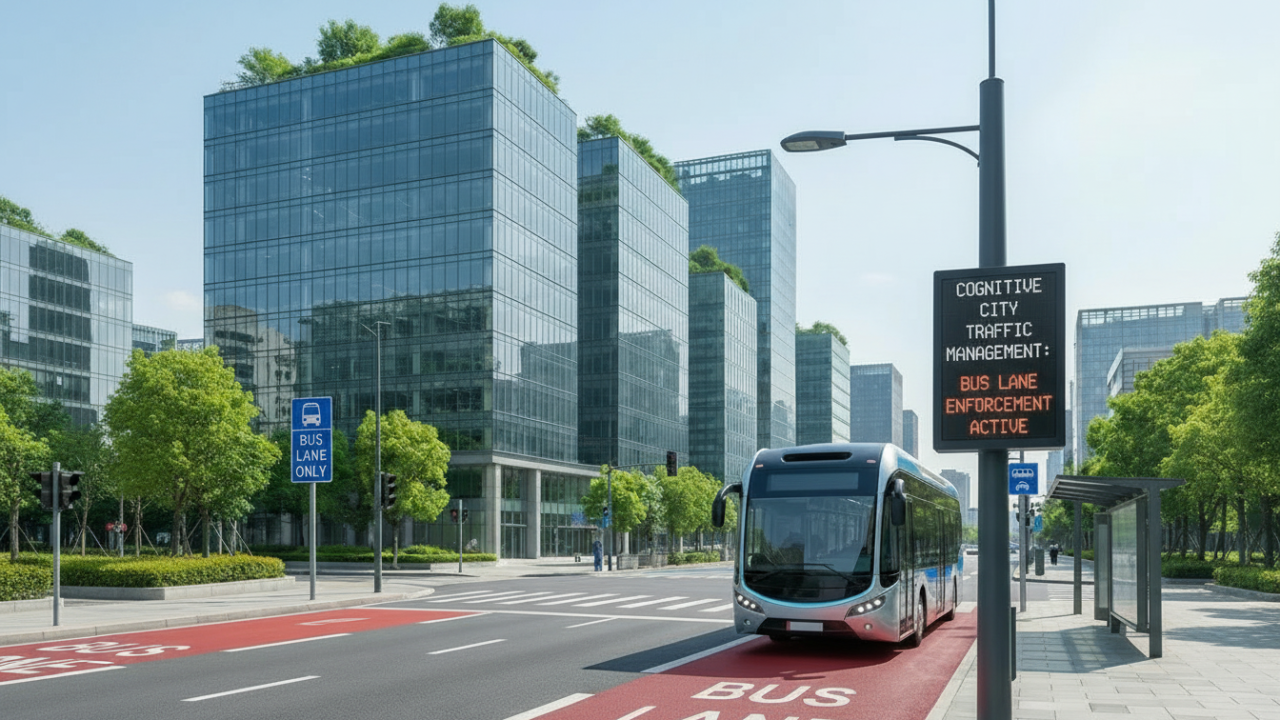
Using Vision-Language Models (VLMs) for Bus Lane Enforcement
Bus lanes are among the most powerful—and most fragile—tools cities have to improve mobility. When enforced correctly, they reduce travel times, increase transit reliability, and make public transportation more competitive with private vehicles. When enforcement is inconsistent or overly manual, bus lanes quickly degrade into symbolic paint on asphalt.
Vision-Language Models (VLMs) fundamentally change this equation.
From Rule-Based Vision to Contextual Understanding
Traditional automated bus lane enforcement relies on narrow, rule-based computer vision: detect a vehicle, read a license plate, check time and location, and issue a citation. While effective in controlled conditions, these systems struggle with real-world complexity—temporary signage, construction zones, emergency vehicles, delivery exemptions, weather, occlusions, and ambiguous edge cases that require human judgment.
VLMs introduce a new capability: contextual reasoning. Instead of merely detecting pixels, a VLM understands the scene semantically. It can interpret signage, lane markings, curb geometry, vehicle behavior, time-of-day rules, and exemptions—much closer to how a human enforcement officer reasons about a violation.
How VLM-Based Bus Lane Enforcement Works
A VLM-powered system mounted on buses or municipal fleets continuously observes the roadway. When a potential violation occurs, the model doesn’t just ask “Is there a car in a bus lane?”—it asks “Is this vehicle unlawfully occupying the bus lane under current rules and conditions?”
This includes:
Understanding bus lane signage and variable restrictions
Distinguishing permitted vehicles (buses, emergency vehicles, authorized deliveries)
Reasoning about temporary conditions like construction or blocked travel lanes
Evaluating duration and intent (brief avoidance vs. sustained obstruction)
Generating a natural-language explanation of why an event qualifies as a violation
The result is fewer false positives, higher citation defensibility, and dramatically improved public trust.
Mobile Enforcement at City Scale
One of the most powerful advantages of VLMs is that they enable mobile enforcement. By deploying cameras and edge AI on buses themselves—or other city vehicles—cities turn everyday operations into a continuously moving enforcement network. Coverage expands from a handful of fixed locations to entire corridors, routes, and neighborhoods, without installing new roadside infrastructure.
This model scales naturally:
More buses = more coverage
More miles driven = richer data
More context = better models over time
Beyond Enforcement: Data That Improves Cities
Because VLMs generate structured data and natural-language descriptions, the same system that enforces bus lanes also produces actionable insights:
Chronic blockage hotspots
Peak violation times by corridor
Correlation between violations and bus delay
Impacts of curb policy changes or street redesigns
This transforms bus lane enforcement from a revenue tool into a mobility optimization system, aligning transit agencies, DOTs, and city leadership around measurable outcomes.
Why This Matters Now
Cities are under pressure to do more with less—improve transit reliability, reduce congestion, and increase safety without expanding headcount or infrastructure. VLM-based bus lane enforcement delivers exactly that: automated, explainable, scalable enforcement that adapts to the real world rather than forcing the city to adapt to the limitations of legacy technology.
One Platform, Many Outcomes: Bus Lane Enforcement and the Rise of Self-Healing Cities
EchoTwin’s Cognitive City platform is built on Physical AI—AI systems that don’t just analyze data, but actively observe, understand, and interact with the real world. By combining Vision-Language Models, edge-based sensing on moving vehicles, and city-scale digital twins, EchoTwin creates a continuously learning representation of the city that can see changing conditions and reason about what action is required. This foundation extends far beyond bus lane enforcement: the same Physical AI platform powers infrastructure condition analysis, curb and right-of-way management, safety hazard detection, and operational optimization. Through closed-loop workflows—from detection to resolution to verification—cities evolve from reactive operations to self-healing systems that enforce compliance, manage assets, improve safety, and adapt over time, all through a single unified platform supporting both enforcement and non-enforcement use cases to create safer, more resilient urban environments.