The Year of Intelligence: From Seeing Cities to Thinking Cities
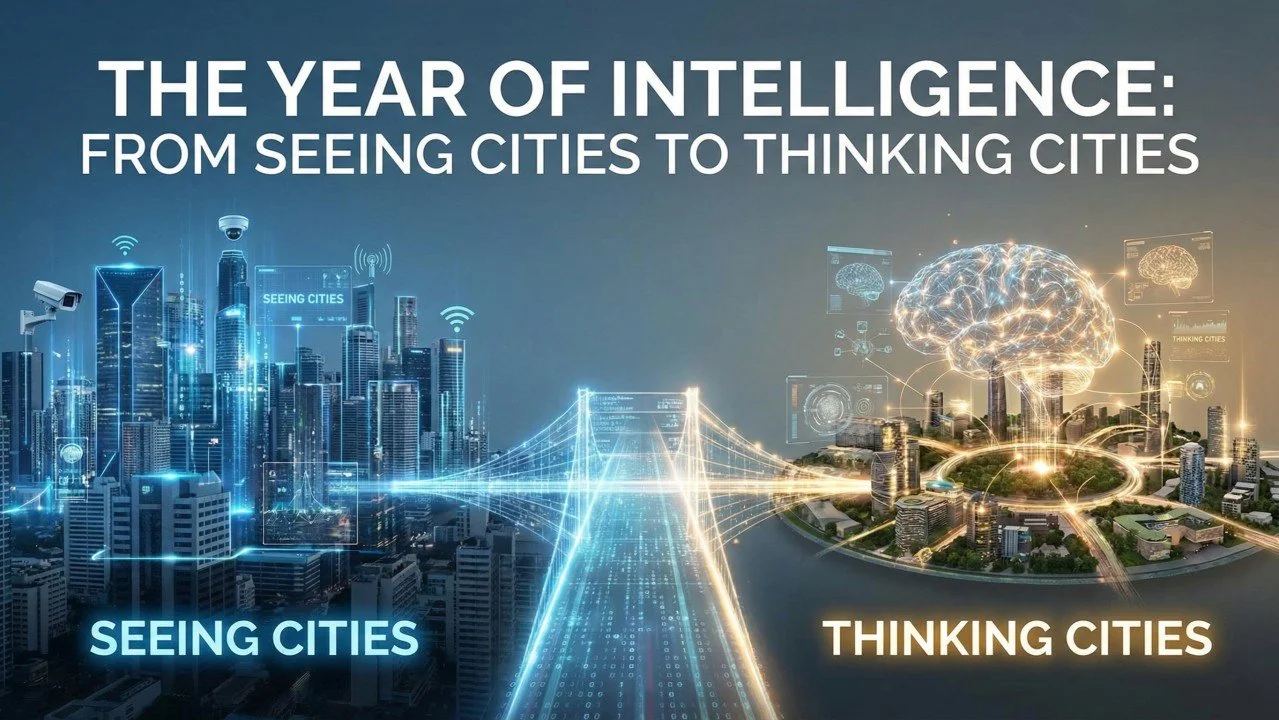
For the last decade, “smart city” mostly meant more sensors, more dashboards, and more data. Cameras got cheaper. Connectivity got better. We learned how to see the city at scale.
But seeing isn’t intelligence.
Intelligence is what happens after the pixels: understanding what matters, what’s changed, what’s risky, what’s non-compliant, what needs action, and what outcome we’re driving toward.
That’s why I believe we’ve entered The Year of Intelligence — the moment cities stop experimenting with vision as a novelty and start deploying operational intelligence as a core public utility.
Why “vision platforms” hit a ceiling
Traditional vision systems were built for narrow tasks: capture footage, flag an object, generate an alert, store evidence. They’re often:
Reactive, not proactive
Event-based, not city-state-based
Siloed, not integrated into work management
Hard-coded, not policy-aware
Static, not continuously learning
They create outputs. Cities need outcomes.
A cognitive city doesn’t just want detection. It wants a continuously updated understanding of reality — and a system that can turn that understanding into action.
What cognitive cities actually need
A cognitive city behaves more like a living organism:
It perceives conditions continuously (not quarterly audits)
It interprets what it’s seeing in context (risk, severity, policy, priority)
It decides what to do next (triage, assign, schedule, enforce, repair)
It acts through existing workflows (work orders, vendors, enforcement, comms)
It learns from outcomes (verified fixes, false positives, repeat offenders)
This is the shift from “computer vision” to city intelligence.
EchoTwin: Intelligence, not just vision
EchoTwin was built for that shift. Our platform is designed to deliver intelligence to cognitive cities in a way conventional vision stacks weren’t architected to do.
1) City-scale understanding, not single-task detection
EchoTwin doesn’t stop at “there’s a problem.” We build a living, versioned digital representation of the city’s assets and conditions — across roads, signs, curb zones, sidewalks, streetlights, markings, and more.
The difference is subtle but profound:
Detection says: “bent pole.”
Intelligence says: “bent pole on a high-risk corridor, worsening over time, affecting ADA clearance, assigned to the right team, with verification criteria.
2) See – Think – Act: closed-loop intelligence
EchoTwin runs a continuous See–Think–Act loop:
See: mobile sensing at scale (fleet-based collection across daily operations)
Think: contextual reasoning (policy + severity + location + change history)
Act: automatic operationalization (tickets, work orders, enforcement workflows, and re-verification)
The platform is built to connect intelligence to execution — because the value isn’t an alert. The value is a resolved issue, a safer street, a compliant corridor, a better-performing city.
3) Policy-aware by design
Cities don’t run on generic “AI confidence scores.” They run on policy: regulations, ordinances, asset standards, SLAs, priority zones, and equity commitments.
EchoTwin is built to support policy-aware intelligence:
Different rules by jurisdiction, street class, or program
Different thresholds by time of day, construction windows, or event plans
Auditability and defensibility for compliance and enforcement
This is what makes intelligence operationally trustworthy.
4) A world model of “what changed,” not just “what exists”
The hardest part of city operations isn’t identifying that something exists — it’s understanding change over time:
What got worse?
What was fixed?
What’s recurring?
What’s spreading?
What’s newly non-compliant?
EchoTwin is built around change detection and condition intelligence, so cities can prioritize what matters and measure outcomes with confidence.
5) Built for outcomes: fewer false alarms, faster resolution
Cities don’t have infinite staff. The right platform reduces noise and increases throughput:
Better triage and prioritization
Better packaging of evidence and context
Faster routing to the right owner
Automated rechecks to confirm resolution
The result is a city that gets smarter every week — not a city that just stores more footage.
Intelligence becomes infrastructure
When intelligence becomes a city utility, everything changes:
Inspections become continuous
Maintenance becomes predictive
Compliance becomes proactive
Budgets become performance-driven
Public trust increases because outcomes are visible and measurable
This is the leap from “smart” to cognitive.
The Year of Intelligence is here
The cities that win this decade won’t be the ones with the most cameras.
They’ll be the ones that can turn everyday operations into a self-improving feedback loop — a city that can perceive, reason, act, and learn at scale.
That’s what EchoTwin was built to do: deliver intelligence to cognitive cities — and help governments move from reactive response to proactive stewardship.
The Year of Intelligence isn’t about seeing more.
It’s about understanding more — and fixing more — faster.