From Static Asset Management to Living Asset Intelligence
Why Cities Are Outgrowing Traditional Approaches—and How EchoTwin Is Redefining the Future
For decades, cities have relied on static asset management systems to track and maintain critical infrastructure—roads, signs, signals, curbs, sidewalks, transit assets, and more. These systems were built for a different era: one where inspections were manual, data was sparse, and change happened slowly.
That era is over.
Modern cities are dynamic, dense, and constantly changing. Infrastructure conditions evolve daily—sometimes hourly—yet most asset management systems still operate on snapshots taken months or even years apart. The result is a widening gap between how cities actually function and how cities see themselves.
This is where the shift from asset management to asset intelligence begins.
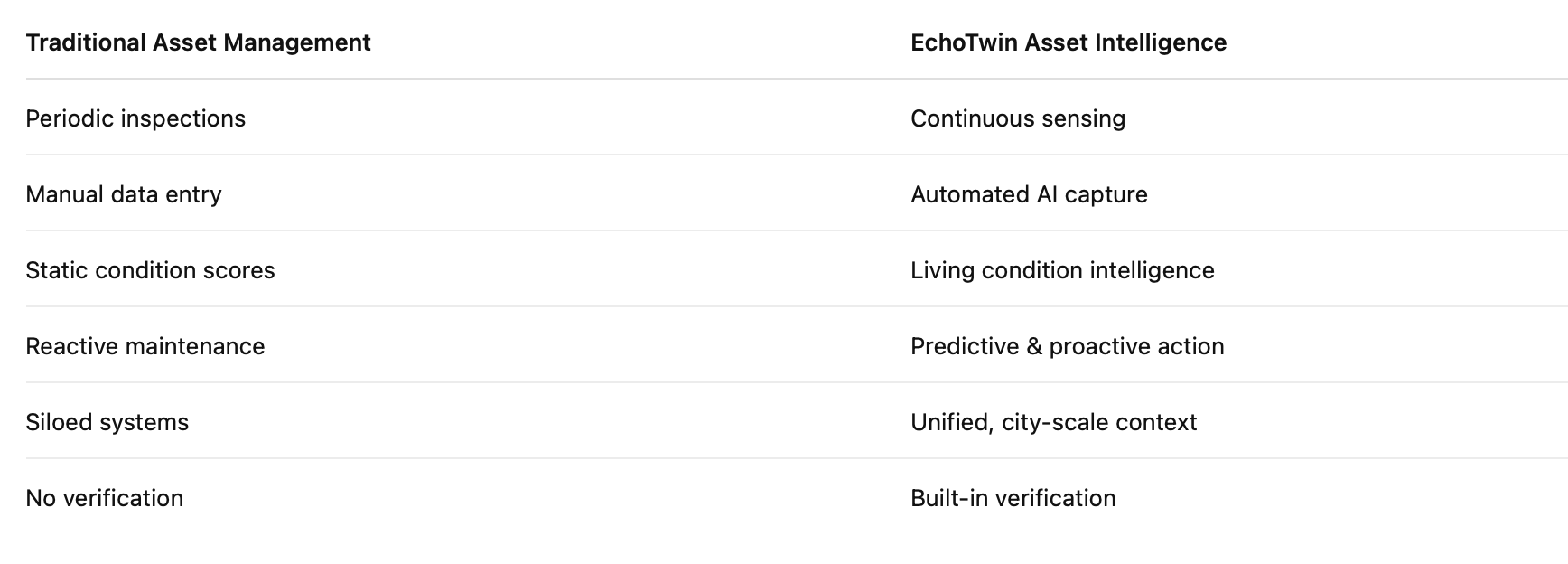
The Limits of Static Asset Management
Traditional asset management platforms are fundamentally record-keeping systems. They answer basic questions:
• What assets do we own?
• Where are they located?
• When were they last inspected?
• What is their assigned condition score?
While useful for inventory and compliance reporting, these systems suffer from core limitations:
1. Infrequent, Manual Data Collection
Most data is gathered through scheduled inspections or citizen complaints—expensive, slow, and incomplete.
2. Static Snapshots, Not Reality
Condition scores represent a moment in time, not the current state of the asset.
3. Little to No Context
Assets are evaluated in isolation, without understanding surrounding conditions, usage patterns, or interactions.
4. Reactive by Design
Issues are discovered after failure, not before.
5. No Closed Loop
There’s limited ability to verify that an issue was resolved—or that it stayed resolved.
In short, static asset management systems store history. They do not understand the present, and they cannot anticipate the future.
EchoTwin’s Asset Intelligence Paradigm
EchoTwin was built from the ground up to answer a different question:
“What is happening to our city’s infrastructure right now—and what should we do about it?”
Instead of relying on static records, EchoTwin delivers living, continuously updated asset intelligence powered by Physical AI.
Always-On Sensing, Not Periodic Inspections
EchoTwin deploys edge-based AI across existing municipal fleets—buses, street sweepers, garbage trucks, inspection vehicles—turning vehicles already driving city streets every day into mobile sensing networks.
No new vehicles. No new routes. No added labor.
Contextual Understanding, Not Just Detection
Using proprietary Vision-Language Models (VLMs), EchoTwin doesn’t just detect assets—it understands them in context:
• Asset type, condition, and severity
• Surrounding environment
• Time, location, and operational relevance
• Policy, compliance, and jurisdictional rules
A faded stop line, a damaged sign, or an obstructed curb isn’t just “logged”—it’s interpreted.
Continuous Updates, Not Annual Scores
Assets are re-evaluated every time they’re encountered. Condition intelligence evolves in near-real time, allowing cities to see deterioration trends before failures occur.
Closed-Loop “See-Think-Act-Verify”
EchoTwin doesn’t stop at insight:
1. See – Detect and classify assets in the real world
2. Think – Apply AI reasoning, policy, and context
3. Act – Trigger workflows, enforcement, or maintenance
4. Verify – Confirm resolution with subsequent passes
This creates a self-healing feedback loop—something static systems were never designed to support.
From Asset Records to Living City Models
At its core, EchoTwin transforms assets from passive records into active participants in a city’s operational intelligence layer.
EchoTwin is not an incremental improvement—it is a category shift.
“Static asset management tells you what you think you own. EchoTwin’s asset intelligence tells you what’s actually happening—right now, in the real world. Cities don’t need another database. They need a living nervous system that can see, reason, act, and verify.” — Chris Carson, Founder & CEO, EchoTwin AI
From Asset Records to Living City Models
At its core, EchoTwin transforms assets from passive records into active participants in a city’s operational intelligence layer.
Why This Shift Matters Now
Cities face increasing pressure:
• Aging infrastructure
• Budget constraints
• Staffing shortages
• Rising citizen expectations
• Greater regulatory and safety demands
Static systems cannot scale to meet these challenges.
Asset intelligence—grounded in Physical AI and real-world context—is no longer optional. It’s the foundation for cognitive cities: cities that can observe, reason, act, and adapt continuously.
EchoTwin: Beyond Asset Management
EchoTwin isn’t an incremental upgrade to asset management software.
It’s a fundamental redefinition of how cities understand and operate their physical world—bridging the gap between the digital twin and the living city itself.
From static records to living intelligence.
From reactive fixes to self-healing systems.
From managing assets to understanding cities.